The tin hat story

Arkle Dunlop began researching the story of this particular tin hat not long after a visit to France in 1984, and a tour of the battlefields where his division had been charged with holding back the German Armoured Panzer divisions in the summer of 1944.
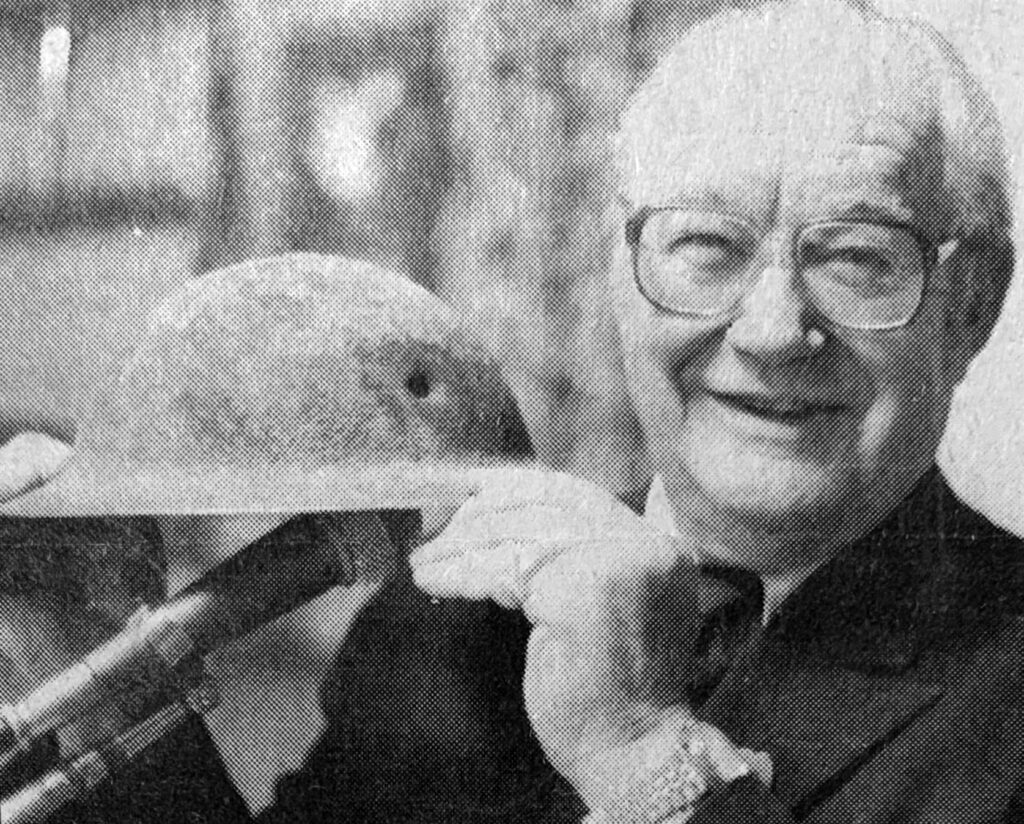
Photo by the Hanover Post

That newspaper photo is from a talk he gave to the Royal Canadian Legion of Hanover, Ontario, in November 1985; and the following account is from the script he sent to Jim Dolmage of the speech he gave at the Lincoln and Welland Regiment’s October 1998 reunion in St. Catharines.


The First and Second World Wars had some things in common: we fought the Germans, in the Low Countries of Europe, and we wore a tin hat. 

The one issued to most of the infantry was the British Army issue: wide brim, low crown, held on your head by a strap under your chin that was connected to the helmet above each ear. Inside the helmet was a leather saddle, which had an air space of perhaps one-half inch on all sides around it, and was attached to the helmet by a rivet at the top. Hats and saddles were of universal size, but the saddle had lacing at the back that could be tightened for anyone with a small pointed head (like some sergeants I knew). I know this equipment quite well; I wore one continuously from July 1944 to May 1945.

Continue reading “The tin hat story”
The Argylls in Tilly

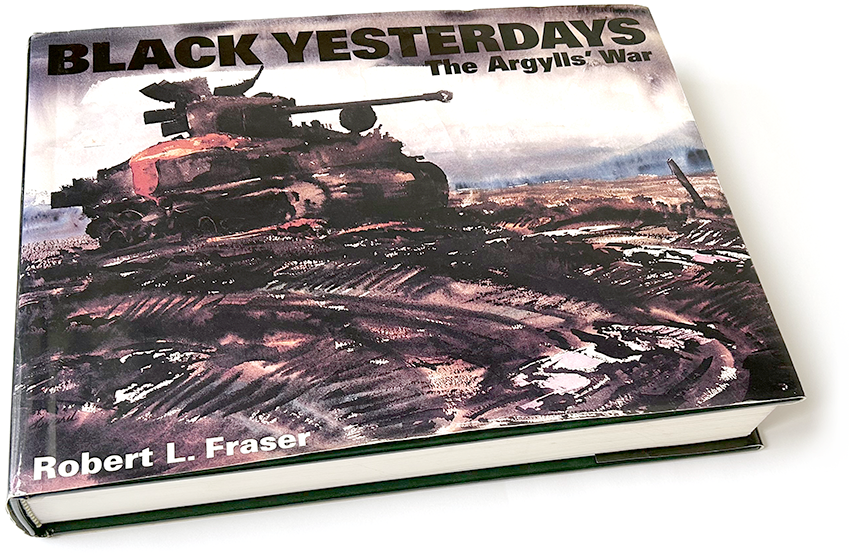
Black Yesterdays: The Argylls’ War—a brilliant book by Robert L. Fraser, PhD—is a narrative of the Canadian soldiers in Europe who served with the Argyll and Sutherland Highlanders. The entries are all first-hand recollections of the men in the battles woven together with the official War Diary.

The Argylls came in to relieve the Lincoln and Welland Regiment, and would endure the same terrible punishment for several days of being commanded to send small groups of soldiers against a massed German army with tanks and heavy artillery in place. This was a strategy of the High Command to keep the large German force in place so they wouldn’t move south and battle against the American troops who weren’t as advanced as the Canadians. Our troops were sacrificed to protect the Americans.

The following excerpts, from pages 211-222 of Black Yesterdays, document that experience in Tilly, in the words of the men who fought there.

Continue reading “The Argylls in Tilly”

Ernie Phair’s war story told in new comic book novel

By Mark Clairmont / Muskoka Today

Today’s war stories are live by the hour on TV—gruesome and graphic as ever. In 1944, during the battle of Normandy, news from the French front was slower returning home than progress marching forward.

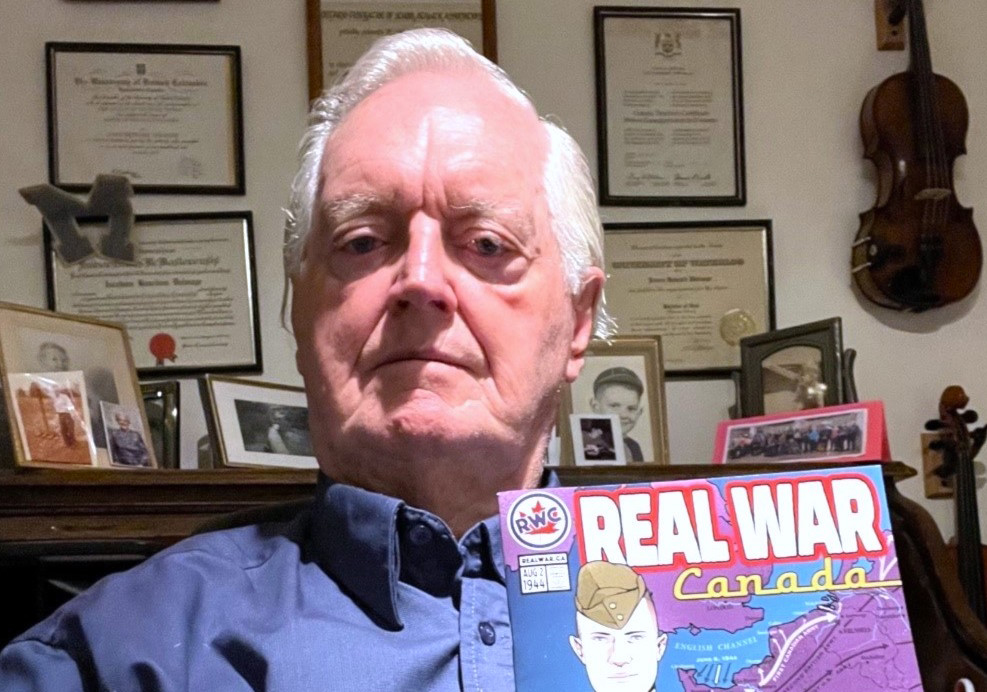
Eighty-two years later, a heroic and tragic story has surfaced in a personalized tale written and published—in comic book form—by Jim Dolmage, a former gym teacher at Gravenhurst High School.

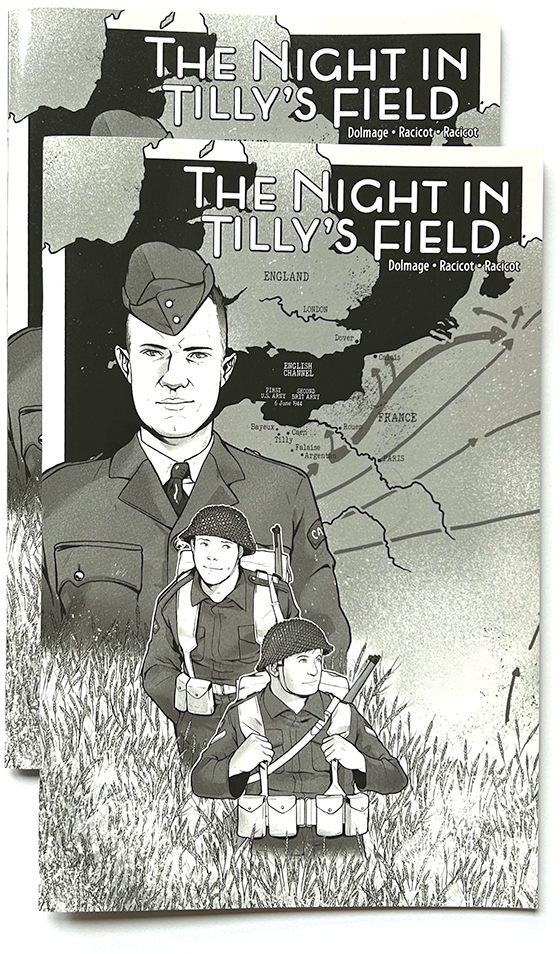
The Night in Tilly’s Field is a graphic novel about his uncle Lt. Ernie Phair and “the men I interviewed who were on the battlefield and witnessed his death.”

The intended audience is teenagers to inform them specifically about the Second World War; but also about wars in general, he says. You don’t need to buy the book “I’m offering it free on line.”

➤ Read the full article

Corporal John MacLean’s story

The anonymous note that Jim Dolmage received in December 2003 included a long newspaper clipping describing the battle at Tilly, its aftermath, and the experience of one of the prisoners taken there. There was nothing in the clipping to indicate the publication nor the subject of the interview, but Jim learned later that these were the recollections of Corporal John MacLean, in his words; and so we’ve transcribed them here. John is mistaken about the date as it was August 2nd this event happened.


Before the light of day on August 4, 1944, a patrol from another company had gone some distance into enemy territory and returned without contact. Later that same morning, before daylight, our patrol was sent into the same area. Evidently, the previous patrol had been spotted by the Germans. The Germans followed the patrol and moved in and set up machine gun positions. When our patrol came along, the Germans allowed the lead section to pass them unharmed before opening fire. At the same time the lead section had passed the German guns, we had received orders to return to our lines.

Before the light of day on August 4, 1944, a patrol from another company had gone some distance into enemy territory and returned without contact. Later that same morning, before daylight, our patrol was sent into the same area. Evidently, the previous patrol had been spotted by the Germans. The Germans followed the patrol and moved in and set up machine gun positions. When our patrol came along, the Germans allowed the lead section to pass them unharmed before opening fire. At the same time the lead section had passed the German guns, we had received orders to return to our lines.

Continue reading “Corporal John MacLean’s story”

Second edition released

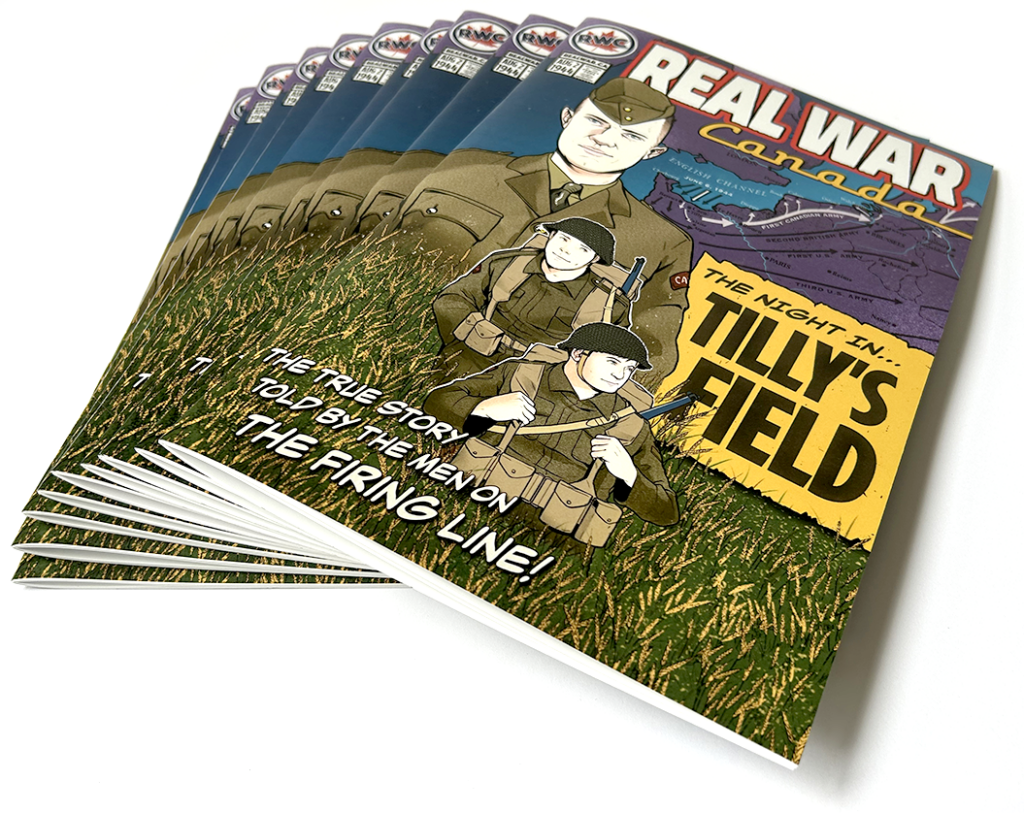
The second edition of The Night in Tilly’s Field is now online and ready to purchase.

Along with several corrections and modifications to the drawings, the dialogue and the writing has been improved for clarity.

On the advice of the experts at The Beguiling in Toronto, we decided to add some colour to the front and back covers. Roy Schulze did yeoman’s work to get everything—the uniforms, terrain, script, and logos—all perfect in a very real semblance of a 1950s war comic. We can only hope that readers will appreciate this melding of comic-book and graphic-novel styles.

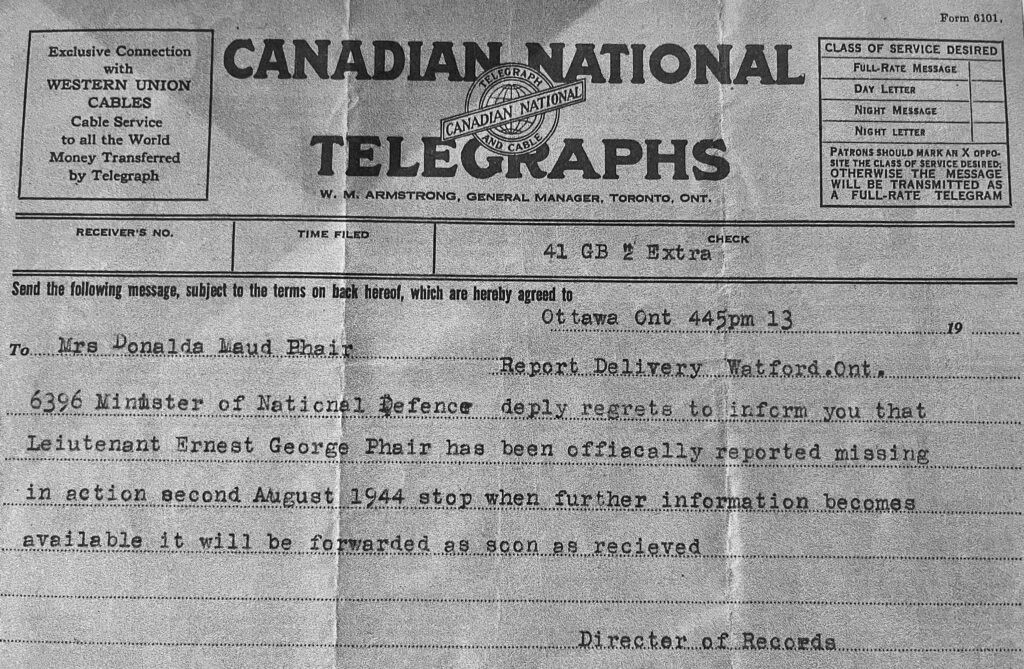
Ernie Phair reported missing

These telegrams were a callous and impersonal method of informing a family that a soldier was “missing.” This one was received by Ernie’s wife, Donalda, on August 13, 1944, who then had to inform their daughter Ann—who was four years old at the time—as well as Ernie’s parents, and the siblings he had reconnected with.

It was assumed that the worst had happened and that he’d been killed . . . but certainly the hope remained that that had not occurred. Meantime, his army wages were suspended, and his insurance policy was not paid out.

It was only in 1945, after Bert Hearnden and Murray Reid had been released as POWs and could confirm Ernie’s death, that Ernie’s wife and family received official notification that he had been killed in action.

Ernie’s letters home

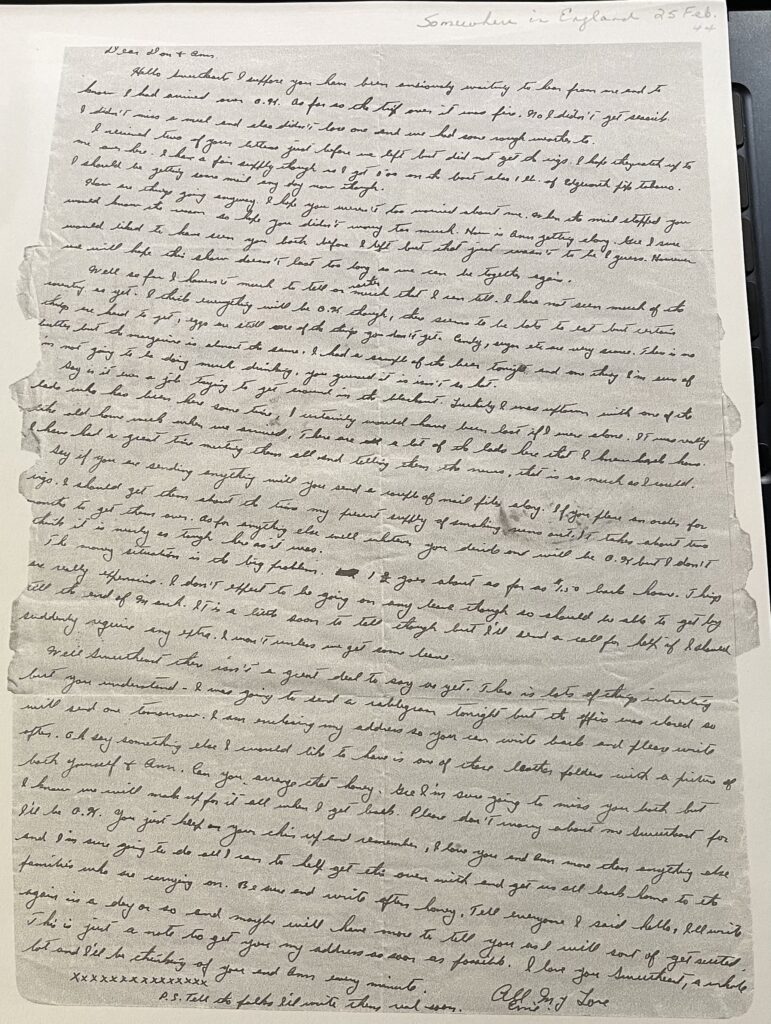
In 1944, during the height of WWII, air mail letters (often called aerogrammes or “Air Letters”) were lightweight, self-sealing stationery, frequently using thin blue paper to save weight on aircraft. These letters often featured military censorship, six-cent or six-pence postage rates, and were vital for connecting soldiers with their families.

Design & Usage: Air Letters (often called V-Mail or “Airgraphs” in earlier years) were introduced to reduce the weight of mail, where the letter sheet folded into its own envelope.

Military Mail: Many 1944 letters were “Postage Free” for soldiers or used six-cent red airmail stamps on blue envelopes.

Censorship: Almost all military letters in 1944 were censored, featuring a censor’s stamp and initials.

His first letter after arriving in England.

February 25, 1944. He always signed his letters “All my love, Ernie.”

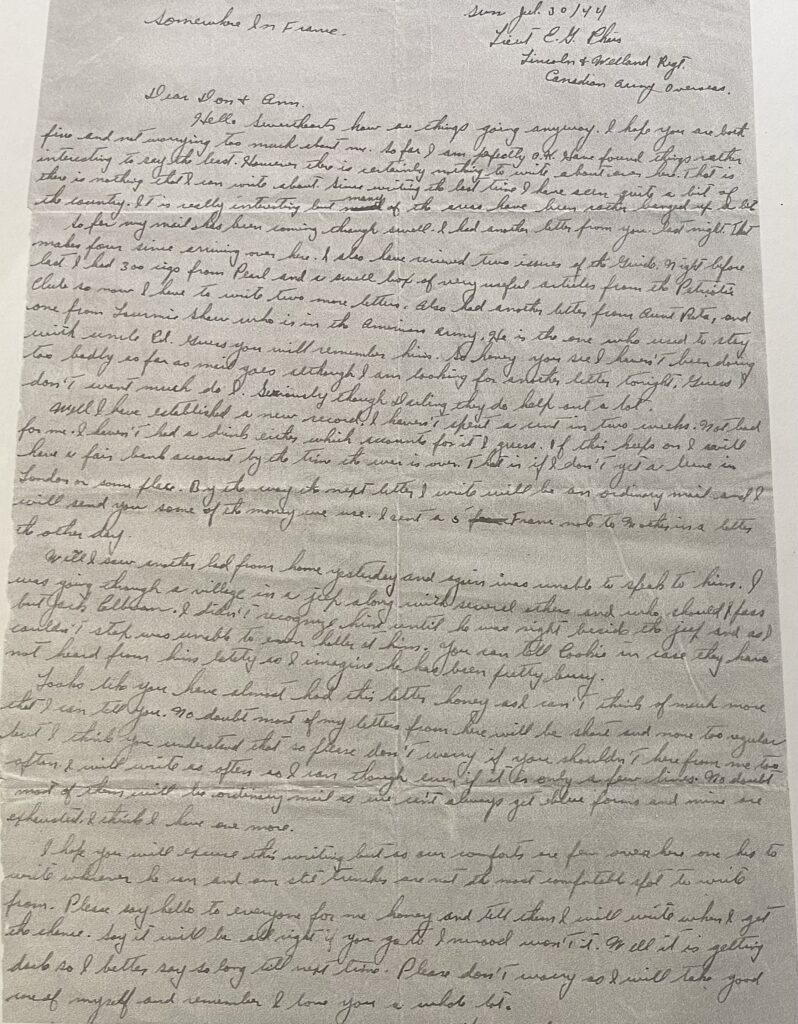
His last letter home

July 30, 1944.

First edition released

We just got the first edition of the The Night in Tilly’s Field back from the printers . . . but only 100 copies to start.

Our intention is to first get it out to the families of Ernie Phair, Arkle Dunlop, Bert Hearnden, Murray Reid, John MacLean, and Jim Dolmage—the people who have helped us so much with this project.

But our hope is to then distribute it to a wide spectrum of readers—with a focus on teenagers—because we feel their feedback is important to correct any errors we may have made and for suggesting improvements for future releases.

Graphic novelists craft the true story of an Ontario soldier who never came home

By Jeff Outhit / Waterloo Region Record

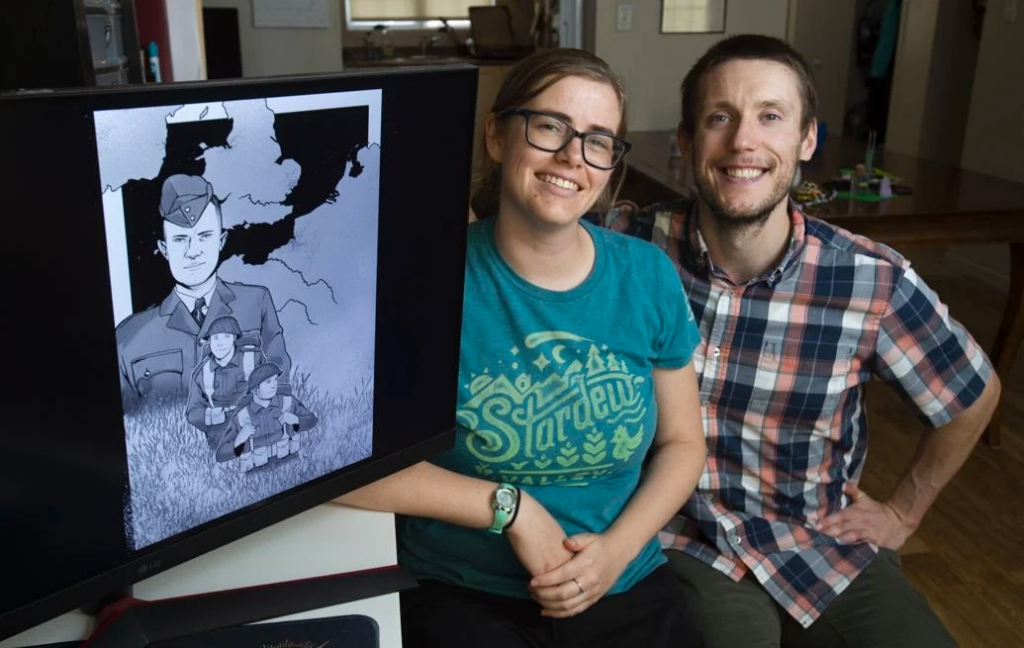
Artists Alaire and Toben Racicot are stepping outside the world of fantasy to create a graphic novel about something true: the story of a soldier who died in the Second World War.

Ernie Phair was a machine operator, husband and new father who enlisted in 1941. By 1944, he was an infantry lieutenant, aiming to lead his men as best he could to help liberate Europe from Nazi tyranny.

“I didn’t want to do a typical story of him being this kind of Captain America figure because I don’t believe that is what soldiers do. They all kind of contribute to one another’s success,” said Toben, a writer.

Alaire and Toben Racicot. Photo by Mathew McCarthy.

“We don’t want to focus on the pain and suffering that these soldiers went through. We want to focus on the characters,” said Alaire, an illustrator.

The Waterloo couple hopes their 32-page graphic novel will connect in a fresh way with students and others, to help them explore the cost of freedom and what it means to remember.

➤ Read the full article