
Arkle Dunlop began researching the story of this particular tin hat not long after a visit to France in 1984, and a tour of the battlefields where his division had been charged with holding back the German Armoured Panzer divisions in the summer of 1944.
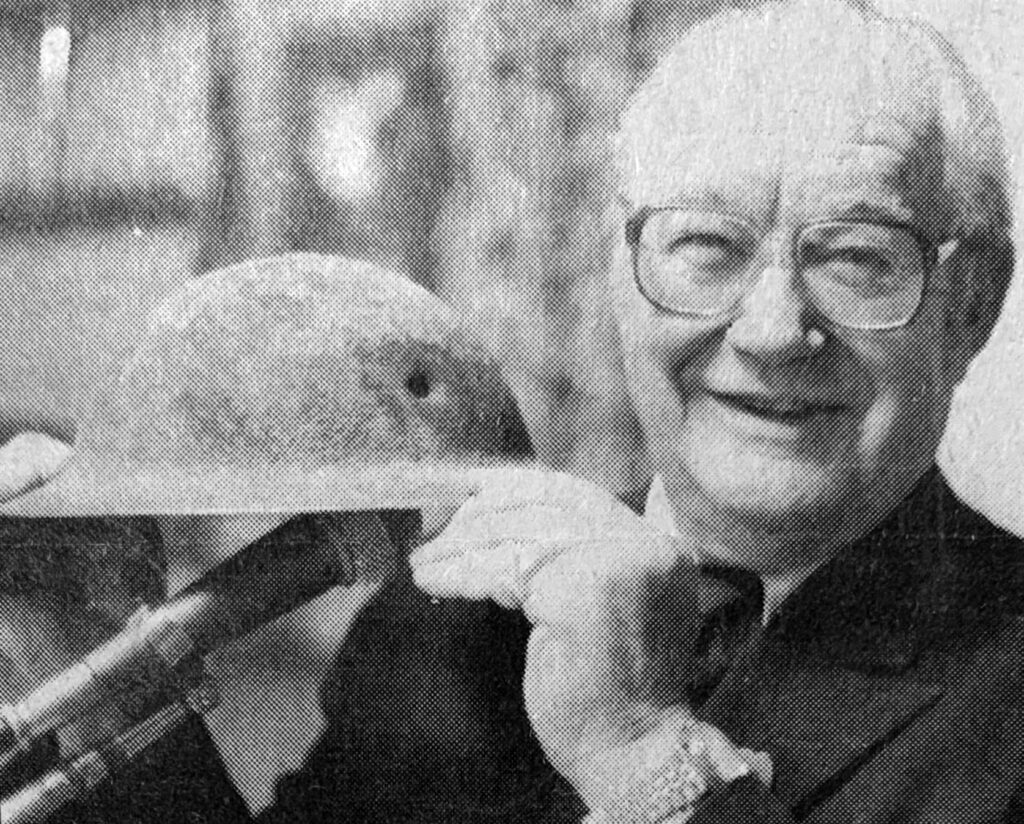
That newspaper photo is from a talk he gave to the Royal Canadian Legion of Hanover, Ontario, in November 1985; and the following account is from the script he sent to Jim Dolmage of the speech he gave at the Lincoln and Welland Regiment’s October 1998 reunion in St. Catharines.
The First and Second World Wars had some things in common: we fought the Germans, in the Low Countries of Europe, and we wore a tin hat.
The one issued to most of the infantry was the British Army issue: wide brim, low crown, held on your head by a strap under your chin that was connected to the helmet above each ear. Inside the helmet was a leather saddle, which had an air space of perhaps one-half inch on all sides around it, and was attached to the helmet by a rivet at the top. Hats and saddles were of universal size, but the saddle had lacing at the back that could be tightened for anyone with a small pointed head (like some sergeants I knew). I know this equipment quite well; I wore one continuously from July 1944 to May 1945.
I have here with me tonight one of the helmets but it has no saddle, no chin strap, and only one strap connector.
On August 20th, 1984, this helmet was given to me by Robert Chombart, a Frenchman who lives near the village of St. Lambert-sur-Dives, in France. That little village was in the direct path of the Germans, when they broke out of the famous Falaise Pocket.
The helmet had been discovered in April 1984 in the mud of the Dives River that runs across the French countryside in a northerly direction and empties into the Channel about a mile east of where the Canadians went ashore on D-Day. The river is narrow, about 12 to 15 feet wide, slow moving, about one foot of muddy water in the bottom, and steeply cut into the French soil—perhaps 10 to 12 feet.
On August 19, 20 and 21, 1944, it was the dividing line between our troops and the Germans in the Pocket.
Looking west from St. Lambert, there is open farm country for about 1200 yards. You come to three main buildings known as the “Moulin,” or mill. Running past the Moulin is the Dives River. I know that piece of country well. On August 19th, I was a Lieutenant in charge of 15 Platoon C Company of the Lincoln and Welland Regiment of the 4th Armoured Division of the Canadian Army. Our company had been sent from the town of Trun to reinforce a small detachment in St. Lambert under the command of Major D.V. Currie of the South Alberta Tank Regiment. He had, under his command, parts of two companies of the Argyll and Sutherland Highlanders of Canada. We were to reinforce them, fill the gaps along the Dives, and shoot some Jerries.
My platoon counted 16 soldiers. We were to take up a position in the Dives, in front of the Moulin. We had a platoon of Argylls on our left and two Sherman tanks in our area to give some firepower. I located one section of five men under command of Corporal J. M. McEachren, dug in on the bank of the Dives. The rest of us were around the three buildings.
In the early hours of August 20th, the Germans made their famous breakout. In the battle that followed—and which lasted until 11 A.M. when we worked our way back to St. Lambert—15 Platoon had four men killed. One was Private S. J. Roberts. McEachren knows, as he saw him die.
Now let us get back to the helmet. A close examination shows, in yellow paint under the rim, Regimental #A118082—which means it originally belonged to Private J. M. Ferrigan, who joined the Regiment January 12, 1944, and was wounded and evacuated at Butcher Hill on the Falaise Heights on August 10th, 1944.
Butcher Hill is over 30 miles northwest of the Moulin, so I know it wasn’t worn by Ferrigan when it fell in the mud of the Dives River. I have tried to locate Ferrigan since the war, because I wanted to ask him what he did with his tin hat when he was wounded. I never found him.
A bit more research says that Private Roberts was an early member of the Lincoln and Welland Regiment having joined in February 1941. He would have been issued a spall helmet.1 By August 1944, the chinstrap probably had worn out—I think it did—so sometime after August 10th, and before the 19th, he picked up Ferrigan’s discarded helmet and wore it until the early hours of August 20th.
McEachren says Roberts was guarding a group of German prisoners down in the bed of the Dives River. He says Roberts was shot through the head by a German who suddenly appeared on top of the bank of the river. A close examination of the helmet shows a neat bullet hole in the back of the crown. There is no mark to show where the bullet came out, which would indicate the bullet entered the back of the helmet on a downward course. I am satisfied Roberts, wearing Ferrigan’s helmet, was instantly killed by that bullet.
Roberts was a quiet, likeable soldier who came from north of Toronto. He told McEachren on the way into St. Lambert on August 19th he didn’t think he’d make it out. He was right.
Currie got the Victoria Cross for that fight. I got the French Croix de Guerre. McEachren got the Military Medal. Roberts got recorded as killed in action.
- A spall helmet was a type of protective headgear worn by tank crews and armoured vehicle personnel. Spall refers to fragments of metal that break off the inside of armour when it is hit by a projectile. Even if a shell didn’t penetrate the tank, these fragments could ricochet inside and cause serious injury. ↩︎